2023-05-24
Creating Natural-Looking Eyelids with Middle-Aged Double Eyelid Surgery
Even those who were once called youthful may find themselves hearing comments about their age due to sagging eyelids and wrinkles. While we cannot turn back time, advancements in medical technology offer various solutions to restore firmness around the eyes.

Even those who were once called youthful
may find themselves hearing comments about their age
due to sagging eyelids and wrinkles as time passes.
Naturally, everyone wishes to always be told they look young and youthful,
wouldn't you agree?
While we cannot actually turn back time,
with the help of advancements in medical technology,
various methods are emerging to restore firmness around the eyes,
allowing us to address current concerns.
Sagging eyelids can make one look sleepy, tired,
and contribute significantly to an aged appearance.
At this point, it is necessary to check if ptosis is progressing.
Ptosis refers to the drooping of the eyelid
due to weakened muscles that lift the eyelid.
While some individuals are born with this condition,
acquired ptosis, which develops due to aging,
is also common among many people.
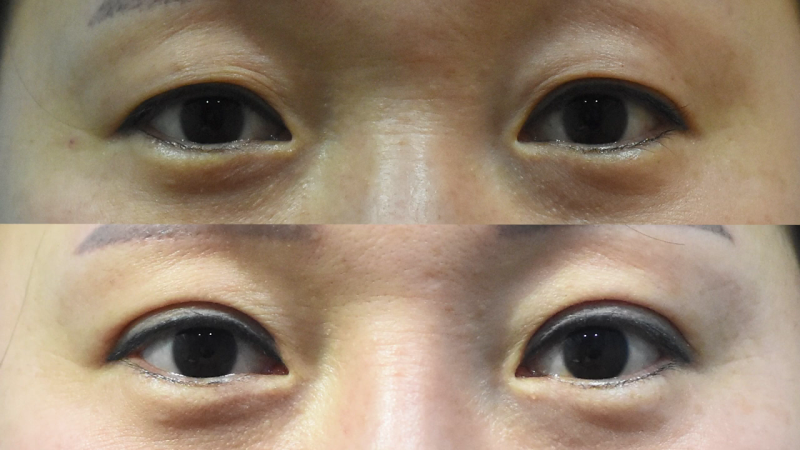
When ptosis makes it difficult to lift the eyelids,
it can cause problems with vision,
increase the likelihood of eye inflammation,
and even lead to vision deterioration,
thus requiring treatment.
For those considering middle-aged double eyelid surgery,
if their condition involves ptosis symptoms,
performing only a middle-aged double eyelid surgery
to create a line
may not yield any significant effect.
Among those experiencing sagging eyelids
who desire middle-aged double eyelids,
many exhibit symptoms of ptosis,
making it necessary to confirm this before proceeding with surgery.
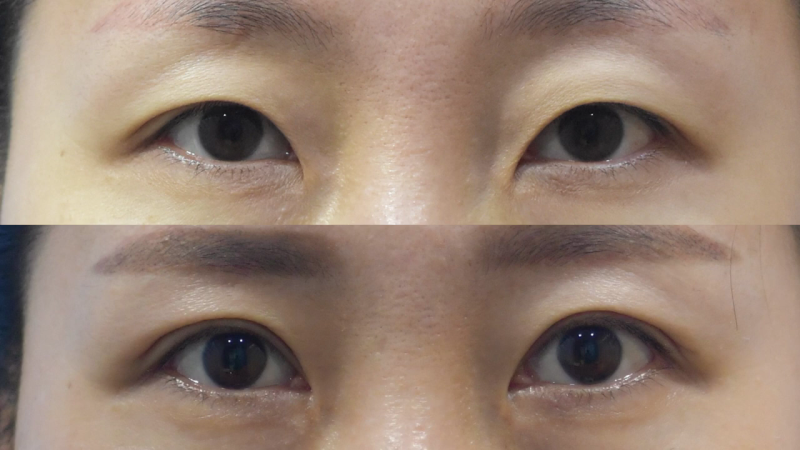
Ptosis can be congenital, due to genetics and family history,
as well as various diseases.
Acquired ptosis is primarily caused by aging,
but can also result from trauma and prolonged contact lens wear.
You can check your condition through a few self-diagnosis questions:
1. You have a double eyelid on one eye, but the other eye is sagging.
2. You feel a sense of obstruction due to an unclear field of vision.
3. You use your forehead muscles to open your eyes, causing wrinkles.
4. You look sleepy and dull.
5. You tilt your chin up when looking straight ahead.
If several of these apply to your situation,
we recommend visiting for an accurate examination
and receiving treatment.
Middle-aged double eyelid surgery
should be performed differently from cosmetic double eyelid surgery
done at a relatively younger age.
It is necessary to check if other symptoms, such as ptosis mentioned above,
are present in combination,
and to design the surgery by anticipating future changes
in the aging eye condition.
Therefore, there is a need to create a middle-aged double eyelid line
that looks more natural over time than the initial design.
To perform surgery with a forward-looking perspective,
it is essential to consult with a skilled plastic surgeon
who has extensive experience.
With middle-aged double eyelid surgery,
it is difficult to achieve satisfactory results by simply creating a line.
In some cases, fat under the eyes may require fat repositioning
to create a brighter eye appearance,
and in other cases, upper blepharoplasty may be needed
to improve ptosis symptoms simultaneously.
As skin aging begins,
the overall elasticity of the skin decreases.
The skin around the eyes is particularly thin,
making it highly susceptible to sagging and drooping.

Upper blepharoplasty is performed by shortening the eye muscles
to create the power to open the eyes.
However, during the process of creating middle-aged double eyelids,
the distance between the eyelids and eyebrows may become closer,
potentially resulting in an impression that feels constricted.
Since such an outcome can be unsatisfying,
an eyebrow lift can be performed concurrently
to achieve overall balance.
Thus, while middle-aged double eyelid surgery might be perceived
as simply creating a line,
it is important to remember that, unlike double eyelid surgery performed in younger years,
many factors need to be considered
before proceeding.
Those considering eye surgery
often visit with only aesthetic concerns in mind.
However, the eyes are a vital organ
with essential functions for living.
Therefore, surgery must consider
all functional aspects as well.
To proceed with a comprehensive check,
you must understand that it should be performed
by a plastic surgeon who accurately comprehends
and considers the anatomical structure of the eye.
Eye surgery performed in middle age
may lead to various side effects,
and the possibility of needing revision surgery
cannot be ruled out.
While it is true that no surgery or procedure is entirely free from side effects,
if future changes are not anticipated
when creating double eyelids on aging eyes,
changes in line and thickness,
or large scars, inflammation, and swelling
could cause long-term distress, so caution is necessary.
If you are dissatisfied with the design after surgery
or are experiencing various problems,
revision surgery should be performed at least 6 months after the initial surgery.
After 6 months, tissues stabilize,
and hardened areas become softer.
Since good results can only be achieved after inflammation subsides,
please calm any impatience
and wait for the appropriate time.
Eye surgery can address
not only aesthetic and functional issues
but also psychological aspects.
Especially after middle age, changes in appearance due to sagging eyes
can easily lead to psychological withdrawal.
To improve such problems,
eye surgery after middle age
can be a good option.
Please consider it carefully
and consult with a skilled plastic surgeon
before making a decision.
** Please be informed that this post is a promotional post written by Diva Plastic Surgery in compliance with medical advertising laws. **
Frequently Asked Questions
What is ptosis?
Ptosis refers to the drooping of the eyelid due to weakened muscles that lift the eyelid. While it can be congenital, acquired ptosis, which develops due to aging, is also common.
How does middle-aged double eyelid surgery differ from that for younger individuals?
Yes, it differs. Middle-aged double eyelid surgery requires checking for complex symptoms like ptosis and designing the surgery by anticipating future changes in the aging eye condition. It goes beyond simply creating a line to comprehensively consider both functional and aesthetic aspects.
Are there any ways to self-diagnose ptosis?
Yes, there are a few self-diagnosis items. These include having one eye sag, feeling an obstructed field of vision, using forehead muscles to open the eyes, looking sleepy and dull, or tilting the chin up when looking straight ahead.
Can other procedures be combined with middle-aged double eyelid surgery?
Yes, they can. If there is a lot of fat under the eyes, fat repositioning can be considered. If there are symptoms of ptosis, upper blepharoplasty can be performed. If the distance between the eyebrows and eyelids is close, making the eyes appear constricted, an eyebrow lift can be considered.
When is revision surgery possible after middle-aged double eyelid surgery?
Revision surgery should be performed at least 6 months after the initial surgery. After 6 months, tissues stabilize and soften, and good results can be achieved only after inflammation subsides.
What is the most important consideration for middle-aged eye surgery?
When undergoing eye surgery, it is crucial to consider not only aesthetic aspects but also the functional aspects of the eye. It is important to consult with a skilled plastic surgeon who accurately understands the anatomical structure of the eye and can predict future changes.